
Oud Grading Explained: What Muhassan, Sinking, and King Grade Actually Mean
If you've spent any time shopping for oud, you've probably run into a wall of grading terms that don't get explained anywhere: AB, Super, Super Plus, Double Super, Sinking, King grade, muhassan. Some sellers use these words loosely, almost as marketing flourishes. We want to walk through what they actually mean, step by step, because each term maps to a real, physical difference in how much resin the wood has soaked up.
It Starts With Resin, Not Marketing
Agarwood (oud) forms when an Aquilaria tree responds to injury or infection by producing a dark, aromatic resin inside its wood. That resin doesn't appear all at once or evenly. It accumulates gradually, in bands and pockets, over years. A young or lightly infected tree might only develop resin near the surface or in a few isolated streaks. A tree that's been producing resin for decades can end up with wood that's saturated almost all the way through. Grading is really just a way of describing how far along that process got before the wood was harvested. The ladder below walks through it from the lightest end to the densest, so you can see how the resin concentration actually builds from one grade to the next.
The Grading Ladder, Step by Step

AB Grade is the entry point. At this level, resin has formed but hasn't gone very deep: you're looking at surface streaking and pockets rather than saturation. The aroma is real and genuinely agarwood, just lighter and more one dimensional, because there's simply less resin mass producing it. This is the most affordable way to own real, wild oud, and it's a fair, honest product at its price point.
AB+ Grade sits just above that. The resin coverage is a bit more consistent across the piece, with fewer completely bare patches. It's a small step up in density and a small step up in how long the aroma holds when burned, but it's still closer to AB than to Super in overall character.
Super Grade is where the resin starts to read as the dominant material rather than an accent on top of plain wood. Streaking gives way to broader saturated zones, the wood visibly darkens, and the fragrance gains more layers. You start getting the shift from a top note into something deeper as it burns, instead of one flat smell the whole way through.
Super Plus Grade pushes that further. The saturated zones from Super grade begin merging into each other rather than sitting as separate patches, so a larger share of the piece's total mass is resin rather than untouched wood. Pieces at this level are noticeably heavier for their size than Super grade pieces of the same dimensions. That added weight is resin, not moisture or anything added.
Double Super Grade is the point where saturation is close to complete but hasn't yet crossed into sinking territory. Most of the cross section of the wood shows resin when you look at a cut piece, with only small unsaturated pockets left. The aroma at this stage is dense and complex enough that it's genuinely difficult to distinguish from sinking grade by smell alone. The real difference at this point is measured in density, not scent.
Approaching the Sinking Threshold. Between Double Super and true Sinking grade is where the physics starts to matter more than the visual inspection. Resin is denser than water (roughly 1.0 g/cm³ and up, depending on the resin), while dry, unsaturated agarwood is lighter than water. A piece only sinks once its average density, resin plus wood combined, crosses that line. That means two pieces can look almost identically dark and saturated on the outside while one sinks and the other doesn't, because the difference is happening inside the wood, not on the surface.

Sinking Grade is a literal, physical test, not a marketing label. We drop the piece in water. If it sinks, the wood has crossed that density threshold: full depth saturation, not just a saturated surface layer. This is a meaningfully higher bar than a piece that's simply heavy or dark; it has to actually sink, every time, to earn this grade.

King Grade is the top of the sinking tier, not a separate category from it. Every King grade piece already sinks, but within sinking grade wood there's still a real range. Some pieces just barely clear the threshold, others are saturated so completely that almost nothing but resin is left. King grade is reserved for that upper end: pieces that don't just sink but sink decisively, with density and aroma complexity that stand out even against other sinking grade wood. Because of that, King grade pieces are individually weighed and assessed one at a time rather than graded in batches. No two are alike, and each one only earns the label after we've personally evaluated that specific piece.
A Different Scale: Muhassan

We're calling this out as its own section on purpose, because muhassan isn't a point on the ladder above. It's a different process entirely, and mixing it into the wild harvest scale is how a lot of shoppers end up confused.
Everything above describes wood exactly as it came out of the tree: however much resin it naturally accumulated is however much it has. Muhassan is different. It starts with genuine agarwood that's then pressed and further saturated with resin, sometimes sourced from the same region's trees, through a slow process that can't be rushed. It's a way of concentrating resin beyond what that particular piece of wood would have reached on its own through natural growth alone.
Because it's a separate process, muhassan has its own internal grading, and it runs on the same basic idea, increasing resin saturation, but shouldn't be compared rung for rung against the wild harvest ladder above:
Super Muhassan is pressed and saturated to a density comparable to what you'd see in high end wild harvest Super or Super Plus material, but achieved through the pressing process rather than purely through decades of natural resin accumulation.
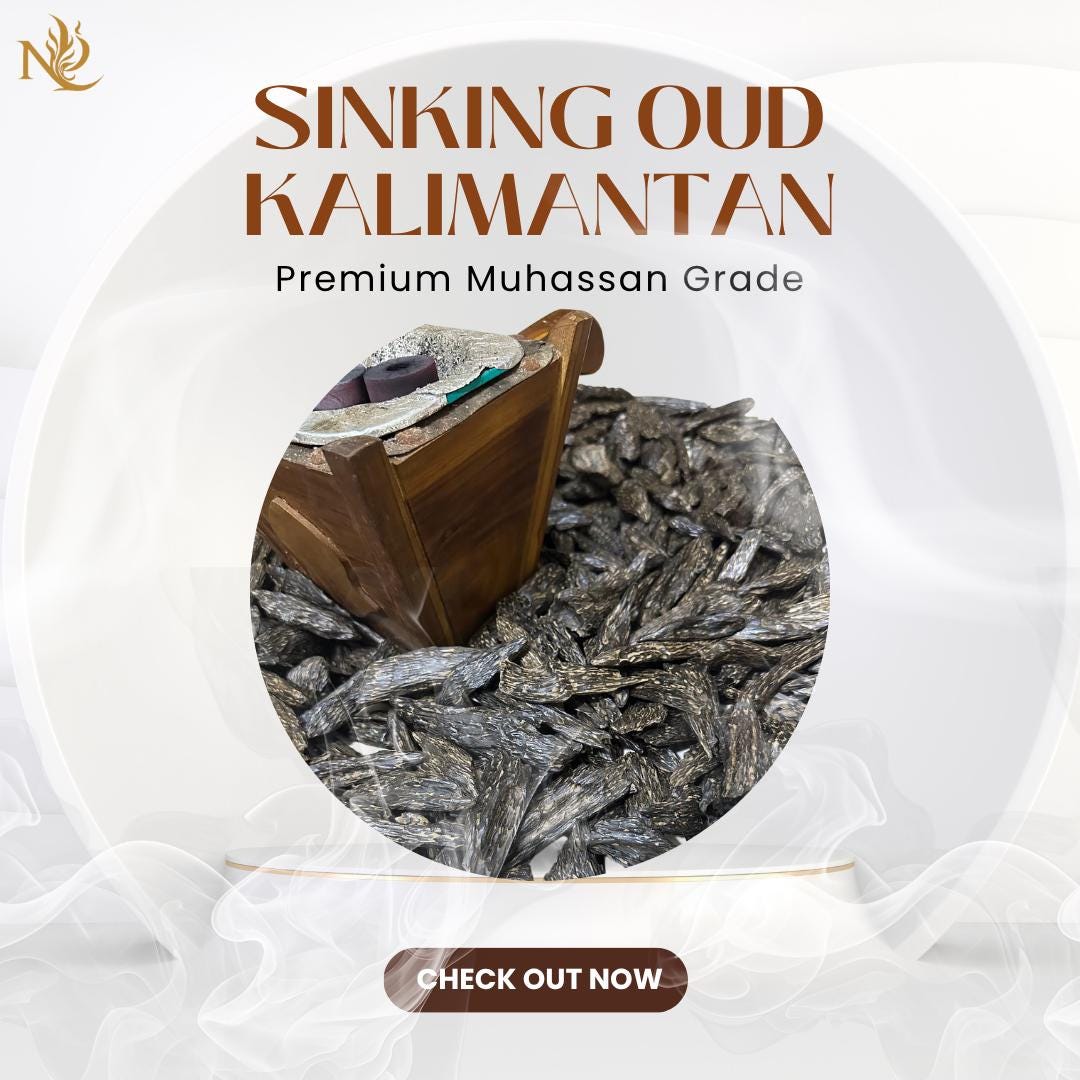
Sinking Muhassan is pressed further, to the point where it also clears the water test. Our Kalimantan Sinking Oud Chips are muhassan pressed to this level. It sinks for the same physical reason wild sinking grade wood sinks: density exceeding water's, but the path to get there was different, which is exactly why we keep it in its own category instead of folding it into the wild harvest sinking grade above.
If a listing is muhassan, we say so directly. It's not a lesser product, it's just a different one, and we'd rather you know which type of "sinking" you're actually buying.
Why We Also Use Grade A and Grade AAA

Separately from the raw wood grading above, we use Grade A and Grade AAA to describe our finished oud oils. Grade A covers the large majority of our oud oil line, oils distilled from good, honest wood that we stand behind. Grade AAA is reserved for a small handful of oils, currently our Wild Kynam, Rare Wild Hainan, and Hainan Insect oud oils, where the source wood, the aging, and the extraction method are all a step above the rest of the catalog. We don't hand out AAA loosely. It's meant to mean something.
The Point of All This
None of these terms are meant to be a marketing layer on top of the product. They're supposed to tell you, honestly, how much resin you're actually getting and how that wood got there: gradually, from the tree, or pressed, through muhassan. If a batch's grade or origin ever isn't clear from the listing, email us at support@noblearoma.com, we're always happy to talk through what we know about a specific batch.